 |
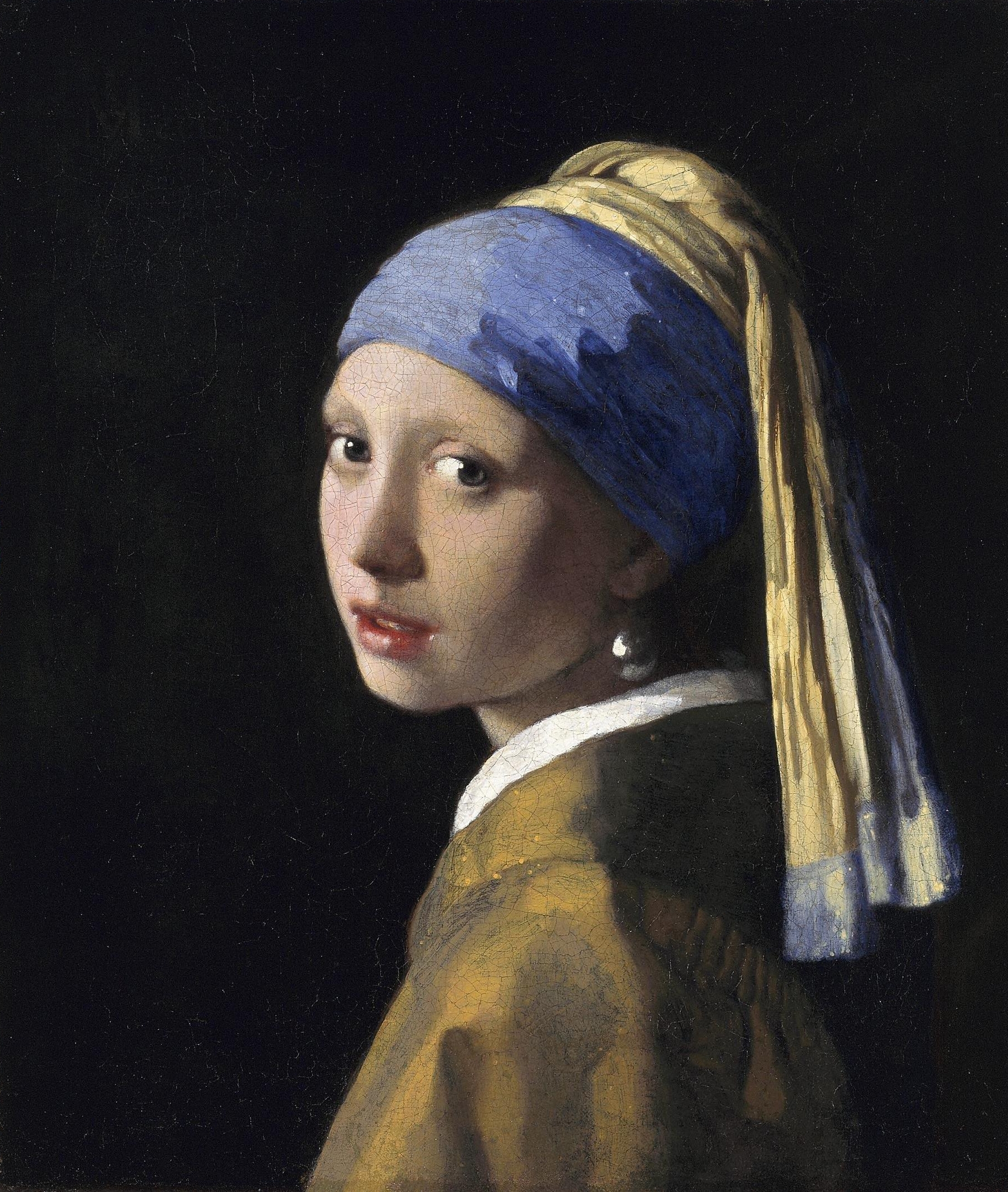
| Girl with a Pearl Earring Johannes Vermeer, Public domain, via Wikimedia Commons |
The Artistic Characteristics of Vermeer’s Girl with a Pearl Earring: A Second-Person, Showing-Style Exploration
You find yourself standing in front of a face that feels impossibly alive. Her lips glisten as if she has just drawn in a soft breath.
Her eyes—wide, clear, and urgent—lock onto yours as though she has been waiting for you. In this moment, Vermeer’s Girl with a Pearl Earring is no longer a painting; it is a presence.
You feel her gaze land on you, not as a distant subject from the 17th century, but as someone who exists right now, in your space, breathing the same air.
The room around you seems to fade, and soon there is only her: the girl turning toward you, illuminated by a light so gentle you feel it warm across your own skin.
This is Vermeer’s mastery—he pulls you into the painting’s intimate world not with action, but with stillness filled with pulse and possibility.

Girl with a Pearl Earring [Cropped] Johannes Vermeer,
Public domain, via Wikimedia Commons
Light That Touches You Before You Notice It
Public domain, via Wikimedia Commons
As you let your eyes rest on her face, you begin to feel the subtle choreography of light guiding your attention.
The illumination pours in from the left, brushing across her cheek, softening the curve of her jaw, and tracing the delicate bridge of her nose.
You watch how the highlights shimmer faintly on her moist lips, making them appear as if they might part at any moment to speak.
The shadows cradle the light carefully—not swallowing it, but shaping it. The right side of her face retreats gently into darkness, giving volume to her features and pulling you deeper into her expression.
You sense Vermeer’s sensitivity in how he balances brightness and shadow, creating not just visibility but mood. The contrast allows her face to emerge like a quiet revelation.
Her eyes seem to glisten with the same light. You see tiny reflections gathered at the edges of her irises, giving her gaze its unmistakable immediacy. She looks as though she feels something—curiosity, surprise, perhaps the beginning of a question—and you stand there trying to decipher it.

Girl with a Pearl Earring [Cropped] Johannes Vermeer,
Public domain, via Wikimedia Commons
Color Used Like a Whispered Invitation
Public domain, via Wikimedia Commons
You notice the vibrant blue first. It wraps around her head in a turban that falls in soft folds, its ultramarine glow made from pigments more precious than gold in Vermeer’s time.
You feel the color, cool and calm, guiding your gaze across the painting. It isn’t loud; it is confident, intentional, magnetic.
Then you see the warm yellow fabric draped across the blue, a gentle contrast that adds warmth without overpowering the scene. These colors do not fight—they converse. You sense Vermeer’s careful hand in how he pairs them, balancing richness with restraint.
Her clothing, a muted brownish golden tone, settles her into the dark background, allowing the vivid blue and yellow to shine. Yet even in its simplicity, the garment feels tactile. You imagine your fingers grazing the fabric, sensing its worn smoothness and pliability.
The background itself—a velvety darkness—creates an almost theatrical stage for her. Without details or distractions, it allows the colors of her clothing and the soft flesh tones of her skin to pull you forward, closer, until the world behind you seems to dim.

Girl with a Pearl Earring [Cropped] Johannes Vermeer,
Public domain, via Wikimedia Commons
Texture You Can Almost Feel Against Your Skin
Public domain, via Wikimedia Commons
You find yourself tracing the textures with your eyes as though they might respond to your touch. The pearl—her pearl—sits against the light like a delicate drop of moonlit water.
It has no hard outline, only the soft reflection of her world captured in one small highlight. You feel its smoothness before you even fully register it.
Her lips appear slightly parted, and you imagine the faint dampness there. The skin of her face is smooth and warm in tone, painted with glazes so thin they might be breathing.
The headscarf, by contrast, feels textured, weighty, its folds holding the memory of the hands that might have tied it.
Texture is everywhere yet nowhere overt. It does not demand attention; it simply exists—quietly real, quietly human.

Girl with a Pearl Earring [Cropped]
Johannes Vermeer,
Public domain, via Wikimedia Commons
Composition That Moves You Without Letting You Move
Johannes Vermeer,
Public domain, via Wikimedia Commons
You begin to sense the deliberate arrangement of forms that make her turning gesture feel so immediate.
The three-quarter pose gives you the sensation that she has just shifted, just turned toward you, maybe even responding to something you said. Her body faces away, but her head swivels toward you with a suddenness that feels alive.
The diagonal lines in the folds of the turban and the fall of her garment subtly direct your gaze toward her face.
Her eyes pull you first, then the pearl, then back again. You feel Vermeer’s invisible hand guiding your vision in a gentle loop, ensuring that your attention lingers exactly where he wants it to.
The dark background acts as a quiet stage. Without depth cues or surrounding objects, the girl steps forward into your space, closer than most portraits dare to come. The emptiness behind her creates an intimacy that makes you almost forget you’re looking at paint.

Girl with a Pearl Earring [Cropped] Johannes Vermeer,
Public domain, via Wikimedia Commons
Expression That Breathes Emotion into the Stillness
Public domain, via Wikimedia Commons
You watch her expression shift as you continue to study her. The tilt of her head, the softness of her lips, the clarity of her eyes—they combine to create something that feels like a moment suspended. You sense anticipation, curiosity, perhaps the beginning of vulnerability. She is not smiling, yet she is not serious. She seems to be asking you something, though the question never arrives.
The painting’s power lies in this ambiguity. You fill in the silence with your own thoughts, your own emotions. Her expression becomes a mirror, and you suddenly feel seen.
Symbolism That Murmurs Rather Than Speaks
You notice that the girl’s adornment—the pearl—glows softly against her skin, catching the light with quiet radiance. Pearls in Vermeer’s time often symbolized purity, wealth, or transformation. Yet here it feels less like a symbol and more like a whisper, something that deepens the sense of mystery rather than explaining it.
Everything symbolic in this painting exists in undertones: the exotic turban that suggests imagination and fantasy, the darkness that hints at the unknown, the pearlescent glow that draws attention to her youth and luminosity. Nothing about the symbolism forces interpretation; instead, it invites it.
A Presence That Follows You Beyond the Frame
The longer you stay with her, the more the painting becomes a conversation. She does not fade back into art; she stays focused on you, steady and gentle. You feel her attention with an intensity that few paintings achieve.
When you finally step away, she does not disappear. Her eyes linger in your mind, her soft breath seems to hover near your ear, and the glow of the pearl rests lightly in your memory.
Vermeer has not shown you a girl—he has shown you a moment. A fleeting turn of the head. A gaze that feels alive. A breath between silence and speech. And you realize that Girl with a Pearl Earring endures because it looks into you as deeply as you look into it.

