 |
| The Sea of Ice (The Wreck of Hope) Caspar David Friedrich, Public domain, via Wikimedia Commons |
The Sea of Ice (The Wreck of Hope) by Caspar David Friedrich: A Landscape of Shattered Forces and Silent Grandeur
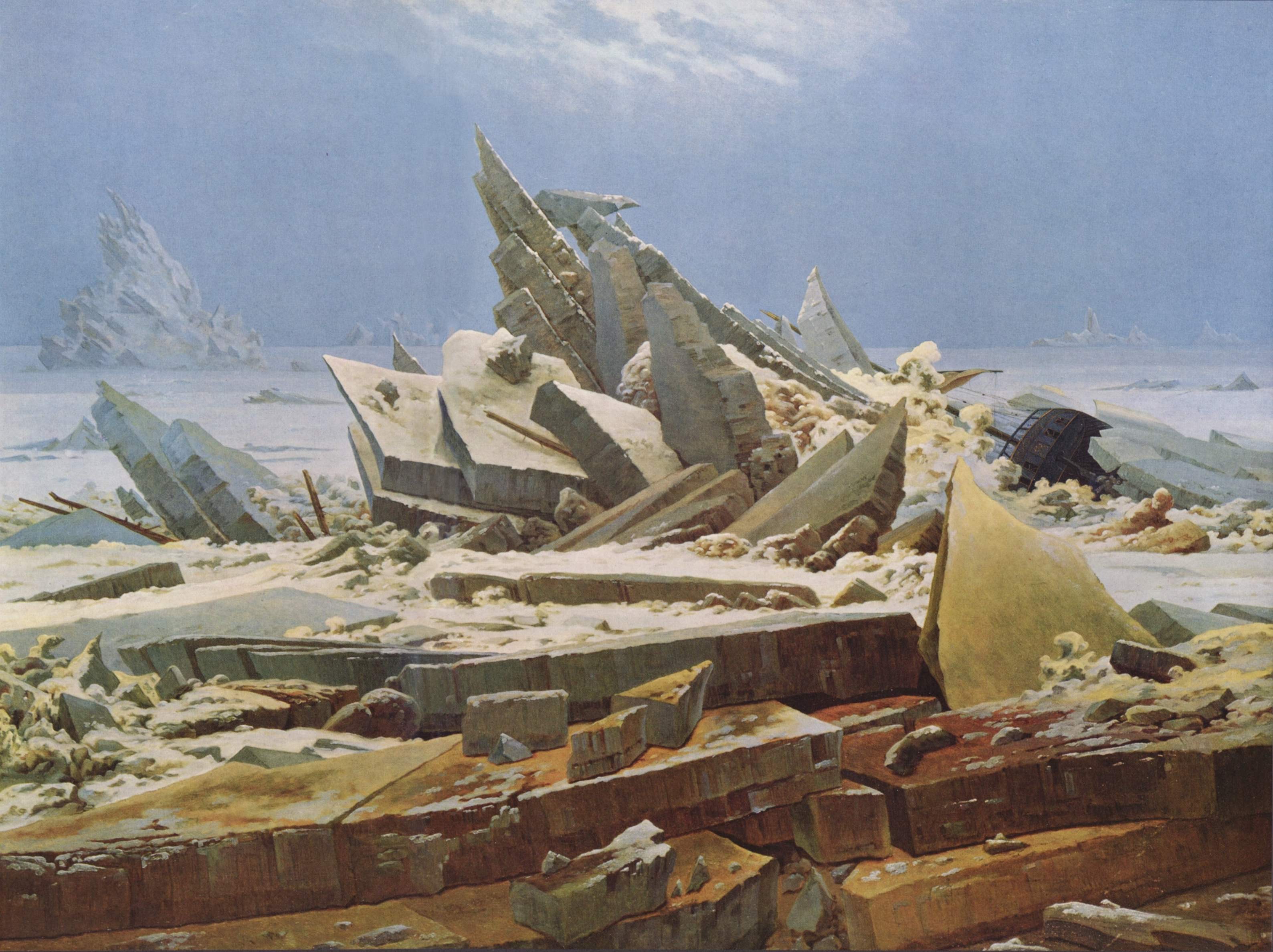
At first glance, the painting chills you—not simply because the landscape is frozen, but because the silence feels absolute. In Caspar David Friedrich’s The Sea of Ice (also known as The Wreck of Hope), jagged towers of ice thrust violently upward as though the earth itself has broken open.
Blocks of frozen sea rise like fractured monuments—blue, white, and corpse-pale yellow—leaning at impossible angles. The scene appears as if nature has just exhaled its cold fury, leaving behind a battlefield where ice, rather than men, has triumphed.
Painted around 1823–1824, this work stands as one of Friedrich’s most uncompromising visions. While many of his paintings reveal quiet contemplation and sublime beauty, The Sea of Ice introduces a harsher truth: the sublime can also be brutal. The painting does not lecture; it shows. It builds its emotional weight through the textures of ice, the collapse of a ship, and the indifferent expanse of a frozen world.
A Ruined Ship Half-Swallowed by the Ice
Near the lower right of the canvas lies the shattered hull of a ship—tilted, splintered, and wedged between slabs of ice like a toy crushed in the fist of a giant. Friedrich does not center the ship; he lets it appear almost incidentally, as if the viewer stumbled upon it after surveying the frozen chaos.
Its timbers jut out like broken ribs. Shadows sink into the crevices between boards. Snow gathers in quiet drifts along the wreckage, softening the wood’s edges in some places and emphasizing its destruction in others. The vessel is not recent in its catastrophe. The way the ice wraps around it—pinning the bow, lifting the stern—suggests a slow, merciless process rather than a sudden collapse.
It is as though the ship has died twice: once through its wrecking, and again through its burial beneath the frozen slabs. The remnants seem to whisper of human ambition, swallowed without ceremony.
|
| The Sea of Ice (The Wreck of Hope) Caspar David Friedrich, Public domain, via Wikimedia Commons |
Ice as Architecture: Monuments of Nature’s Force
The true protagonist of the painting is the ice—vast, jagged, and eerily alive. Friedrich paints it not as smooth sheets but as fractured geometry. The blocks of ice rise in angular planes, sharp enough to cut the sky.
Light glints off their edges, catching hints of green and blue beneath the white. Some slabs lean precariously; others stand upright like obelisks or tombstones.
The largest structure in the center of the painting tilts sharply upward, its apex pointing toward the pale sky as if signaling triumph. It resembles a crystalline mountain uplifted by some subterranean force. Friedrich builds this mass with overlapping planes, each catching light differently. It is impossible to take it in at a single glance—your eye must travel up its ridges, over its surfaces, tracing the conflict between solidity and fragility.
Some ice slabs appear translucent, their inner shadows suspended like fossils. Others are opaque, chalky, and brutal. Together they form a sense of movement despite their frozen nature, as though the whole mass might shift again at any moment.
|
| The Sea of Ice (The Wreck of Hope) Caspar David Friedrich, Public domain, via Wikimedia Commons |
A Palette of Cold Fire
The painting’s colors are restrained yet powerful. Friedrich uses a range of icy blues—some tinged with green, some fading into gray—to build the frigid atmosphere. The whites are never pure white; they hold hints of ochre, lavender, and smoke. These subtle shifts make the ice feel ancient, layered, and alive.
The sky transitions from pale yellow near the horizon to muted gray-blue above, giving the scene the light of a sun that exists but does not warm. This faint, unsettling glow creates the sense that the world is illuminated by reflection rather than direct sunlight, as though the light comes from the ice itself.
The wrecked ship introduces the only warm tones in the painting: deep browns, blackened wood, ochre shadows. These warm colors make the ship feel painfully mortal, especially against the immortal cold of the frozen expanse.
|
| The Sea of Ice (The Wreck of Hope) Caspar David Friedrich, Public domain, via Wikimedia Commons |
A Landscape Without Footsteps, Without Sound
One of the painting’s most haunting features is the absence of any human figure. No footprints disturb the snow. No birds circle overhead. No smoke rises in the distance.
This emptiness is not a void—it is a presence. Friedrich paints the silence the way others paint clouds or trees; it becomes a physical thing.
The lack of human presence invites the viewer to become the solitary witness. You feel as though you’ve stumbled upon a world after the end of the world—untouched, unforgiving, and utterly indifferent.
Composition That Draws the Eye Into Disaster
Friedrich constructs the composition as a diagonal ascent. The ice mass rises sharply from the lower left toward the upper right, creating a sense of climbing motion. The shipwreck is caught in this diagonal thrust, its angles mirroring those of the ice. This shared directionality suggests that the same natural forces that formed the icy mountains also crushed the ship.
The eye naturally climbs the lines of the ice toward the highest peak. Once there, the downward slope toward the horizon releases the tension, leading into a distant, flat band of frozen sea. This horizon is faint, almost vanishing, giving the unsettling impression that the world continues indefinitely without changing tone or texture.
|
| The Sea of Ice (The Wreck of Hope) Caspar David Friedrich, Public domain, via Wikimedia Commons |
Romanticism at Its Most Relentless
Where many Romantic works reflect the sublime through beauty—sunsets, ancient ruins, lofty mountains—Friedrich turns to devastation. He does not beautify the wreckage, nor does he soften the ice with decorative touches. Instead, he presents nature’s raw power unfiltered.
And yet, The Sea of Ice is not simply despairing. It possesses a strange, severe elegance. The upward surge of ice suggests resilience, even triumph. The forces that destroyed the ship also carved a new landscape, monumental in its geometry.
In this way, Friedrich shows Romanticism’s darker side: the awe that comes not from harmony but from witnessing nature’s capacity to reshape the world without regard for human ambition.
Details That Reveal the Artist’s Precision
Upon closer inspection, small details deepen the scene’s believability:
-
Fine cracks in the ice catch soft shadows, giving depth to each slab.
-
Thin snow gathers in creases, indicating wind patterns.
-
Tiny reflections glint along the edges of ice blocks, suggesting they have recently shifted.
-
The timber of the ship shows splintering patterns consistent with crushing force rather than impact.
These details accumulate slowly as you look, and the longer you study the painting, the more you feel its cold reach your skin.
|
| The Sea of Ice (The Wreck of Hope) Caspar David Friedrich, Public domain, via Wikimedia Commons |
A Sky That Offers No Comfort
The sky in The Sea of Ice is calm, but its calm is chilling. No dramatic storm clouds roll above; instead, the sky watches quietly, indifferent and unbroken. This serenity makes the jagged ice appear even more violent. The sky’s pale yellows and grays act almost like a wash of numbed light, dulling the emotional warmth that sunlight might have offered.
The horizon line is faint, barely separating sky from ice. This blurring suggests that the world might simply continue in pale emptiness forever.
A Meditation on Human Hope
The painting’s original alternative title, The Wreck of Hope, reveals Friedrich’s metaphor. The ship—symbol of exploration, aspiration, and human endeavor—lies crushed beneath forces beyond its understanding.
And yet, something in the painting resists despair. The ice, for all its brutality, rises toward the sky in sculptural beauty. Nature acts not as an enemy, but as an indifferent creator—destroying one thing as it builds another.
In this interplay of ruin and creation, Friedrich invites contemplation. Hope may be wrecked, but the world continues to shape itself with quiet, relentless power.
A Final Look
Stand before the painting long enough, and you begin to sense the slow shifting of ice, the distant groaning of frozen slabs against one another, the relentless creep of nature reclaiming everything. The ship shrinks in importance. What once seemed a tragedy becomes a small incident in a landscape that existed before it and will exist long after.
In The Sea of Ice, Friedrich does not describe the sublime. He shows it—through the tilt of frozen mountains, the quiet glow of a pale sky, and the splintered bones of a ship swallowed by cold. The painting leaves you with a sensation not of loss, but of awe: a recognition of nature’s power to reshape everything in its path, including us.

