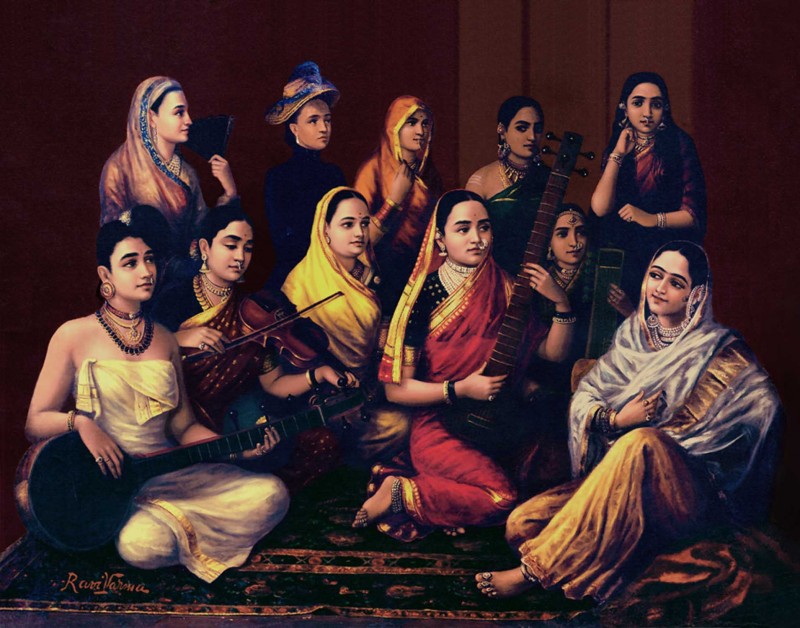
Galaxy of Musicians
Raja Ravi Varma, Public domain, via Wikimedia Commons
Raja Ravi Varma, Public domain, via Wikimedia Commons
INTRODUCTION
The moment one steps into Raja Ravi Varma’s “Galaxy of Musicians,” the room seems to hum. A soft glow pours over a semicircle of women, each poised with an instrument that appears ready to breathe sound into the quiet air.
The painting’s light spreads like morning sun, slipping down silk borders, pooling across polished floors, and warming the expressions of the musicians as though an unseen audience waits just beyond the canvas.
Varma introduces not a static tableau but a performance caught in the breath before its first note.
Women as Living Melodies
Each musician sits with a posture as distinct as her musical lineage. A woman in a deep crimson sari tilts her head slightly as she fingers the strings of a veena, her gaze serene yet alert, as if she hears a melody the viewer cannot. Beside her, another woman with jasmine woven into her hair holds a tambura close to her chest, the long neck of the instrument rising like a slender tower.
Varma lets the edges of their garments rustle visually; even in stillness they vibrate with unplayed music. Their expressions—soft, grounded, ready—echo centuries of inherited artistry.
Fabric That Speaks the Language of Heritage
The real symphony in “Galaxy of Musicians” begins with the saris. They shimmer in shades of ochre, indigo, rose, and ivory, woven with borders that recount the textile traditions of India. Varma paints each silk fold with deliberate care, allowing the fabric to reveal a woman’s origin before her instrument does.
The pleats fall in gentle waves, catching highlights that trace the curves of shoulders and arms. These garments do not function as mere costumes; they breathe identity, status, and regional pride. Viewers can almost feel the softness of the silk and the weight of the gold threads that bind the scene together.
Galaxy of Musicians
Raja Ravi Varma, Public domain, via Wikimedia Commons
Raja Ravi Varma, Public domain, via Wikimedia Commons
Instruments as Silent Storytellers
Varma renders every instrument with the precision of a craftsman. The veena’s polished body reflects a warm glow, while the mridangam’s taut leather seems ready to pulse beneath a rhythmic hand.
A silver flute glints softly, its surface cool and sleek. Even the smallest bells strung around a dancer’s ankle appear alive with potential motion. The painting gathers instruments from multiple regions, arranging them like languages laid side by side—each one distinct, yet harmonizing through Varma’s visual orchestration. Their silent presence invites the viewer to imagine the first collective note rising like incense in the air.
Faces That Hold Entire Traditions
Varma allows the women’s faces to carry the heart of the painting. Some lift their eyes, inviting connection with the unseen viewer; others look inward, as if listening to notes formed deep within. Their expressions are not merely calm—they are steeped in an awareness of the roles they inhabit.
Here sit custodians of musical lineages, women who hold centuries of song in their breath. Varma depicts the calm quiet of focus, the thoughtful narrowing of eyes, and the slight curve of a smile. Each face is a portrait of devotion, making the painting feel less like an assembly and more like a gathering of spirits.
A Hall That Breathes Culture
The setting, though subtle, anchors the painting’s drama. Varma constructs a spacious hall with muted walls and soft shadows, allowing the luminosity of the women and their garments to command attention.
Their hues reflect off the floor, giving the impression that the marble itself is listening. The pillars and arches rise not as grand statements but as gentle frames, guiding the viewer’s gaze from one musician to the next. The buildings act as a silent, steadfast, perceptive, and respectful audience.
Galaxy of Musicians
Raja Ravi Varma, Public domain, via Wikimedia Commons
Raja Ravi Varma, Public domain, via Wikimedia Commons
Unity Across Diversity
“Galaxy of Musicians” earns its celestial title not by extravagance but by harmony. Women from different regions, speaking different musical dialects, gather without hierarchy on the same visual plane.
Their instruments differ, their attire varies, yet their poise forms a single rhythmic pulse across the canvas. Varma paints no tension and no competition—only a quiet celebration of India’s diverse soundscape. The painting becomes a constellation of traditions, each star shining on its own yet contributing to a single radiant galaxy.
A Classic Overture
Ultimately, the painting resembles an overture that is held at its very beginning. Varma suspends time, letting the viewer linger in the sacred pause before the music begins. The women sit ready, their instruments glowing with unspoken promise. The silence turns into a timeless, patient, and luminous form of music. One of Raja Ravi Varma's most immersive pieces is "Galaxy of Musicians," which invites the spectator to do more than just watch; it also invites them to listen with their eyes, feel sound in silence, and enter a space where tradition and art merge into pure presence.

