 |
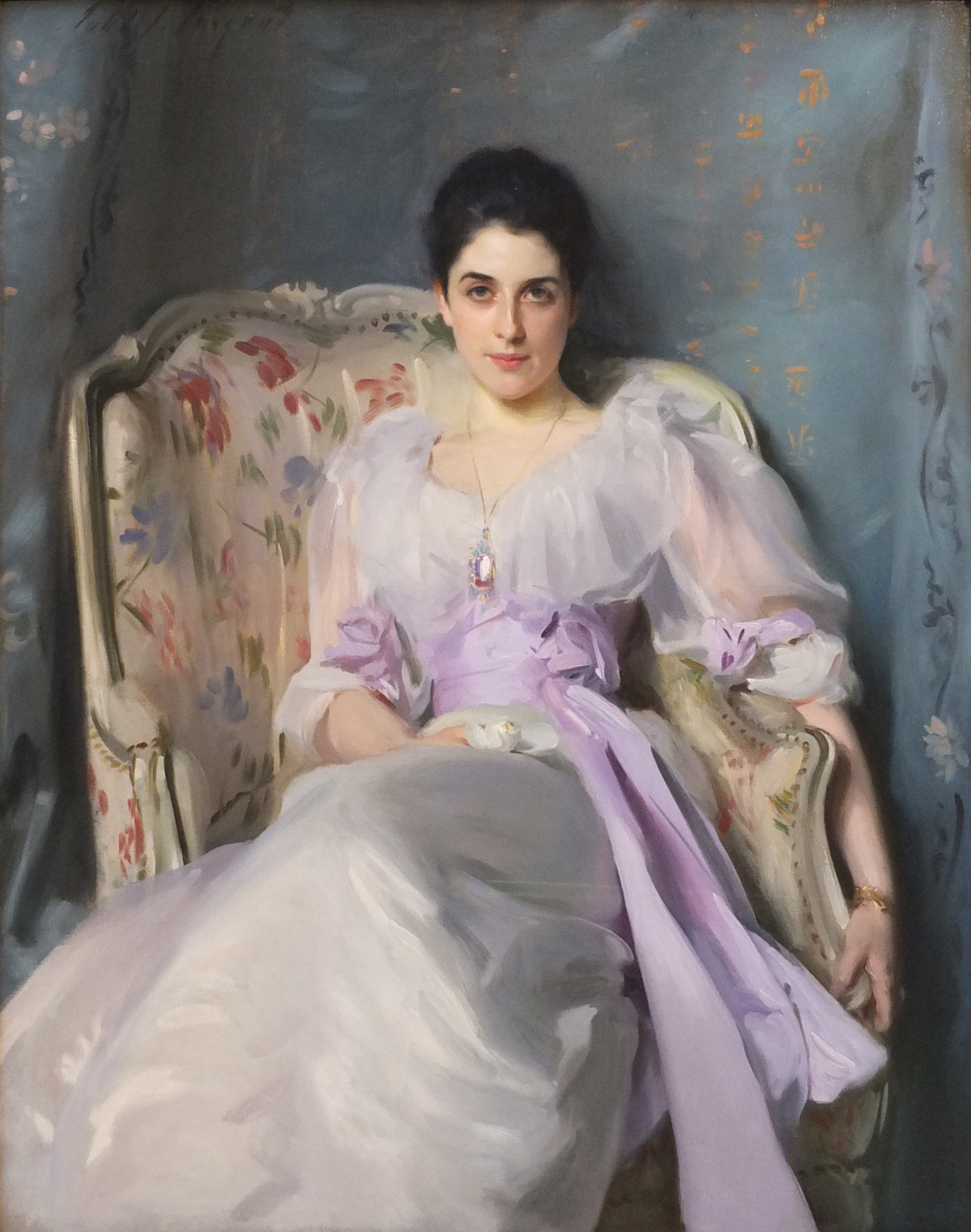
| Portrait of Lady Agnew of Lochnaw John Singer Sargent, Public domain, via Wikimedia Commons |
INTRODUCTION
A woman reclines into the hush of a pale blue interior, her presence felt before it is fully seen. Silk breathes under soft light.
Lace glimmers and then retreats.
In Portrait of Lady Agnew of Lochnaw (1892), John Singer Sargent does not announce his subject with grandeur; he lets her emerge, slowly and irresistibly, from the atmosphere itself.
Her eyes do not confront; they acknowledge. Her gaze and the eyes are steady but soft, aware but unassuming.
There is no theatrical expression, no overt emotion to decode. Instead, the painting offers a sense of inner life held in reserve. The viewer feels observed, yet not judged.
The painting does not speak loudly.
It watches.
It waits.
And in doing so, it reveals the defining artistic characteristics that make this work one of Sargent’s most celebrated portraits.
Atmosphere as Identity
 |
| Portrait of Lady Agnew of Lochnaw [Cropped] John Singer Sargent, public domain, via Wikimedia Commons |
The background is neither blank nor descriptive; it is a field of color that seems to hold sound in suspension.
Blue-gray walls dissolve into one another, absorbing shadows and releasing light in subtle pulses.
This environment does not frame Lady Agnew; it carries her. Sargent uses atmosphere as a psychological extension of the sitter, allowing the setting to echo her composure and restraint.
This technique reflects Sargent’s mastery of tonal harmony. No color stands alone. Whites lean toward lavender, blacks soften into charcoal, and the background blues slip into silvery mist. The result is a space that feels inhabited rather than constructed, as though Lady Agnew has always been there, poised between stillness and motion.
Brushwork That Suggests, Not Describes
 |
| Portrait of Lady Agnew of Lochnaw [Cropped] John Singer Sargent, public domain, via Wikimedia Commons |
The satin gown pools and ripples under Sargent’s brush, its sheen created through contrast rather than detail. Light skims across the surface, leaving highlights that feel accidental yet inevitable.
This economy of brushwork is one of the painting’s most distinctive artistic characteristics.
Sargent shows his hand without showing his labor. The strokes are visible, but they never distract. Instead, they create a sense of immediacy, as if the sitter might shift her weight or lift her gaze at any moment. The painting feels less like a finished object and more like a captured instant, held in delicate balance.
The Pose: Relaxed Authority
Lady Agnew sits at an angle, her body turned slightly away while her face meets the viewer’s gaze. One arm drapes languidly over the chair, fingers relaxed, unguarded. The pose suggests comfort rather than performance. Yet nothing about her presence feels casual. The tilt of her head, the line of her shoulders, the measured stillness of her posture all convey self-possession.
Sargent excels here at portraying social confidence without stiffness. Lady Agnew does not assert herself through grandeur or ornamentation; she commands attention through ease. The chair supports her, the space accommodates her, and the viewer is invited—not challenged—to look. This subtle authority, expressed through posture rather than symbolism, reflects Sargent’s modern approach to portraiture.

Portrait of Lady Agnew of
Lochnaw [Cropped]
John Singer Sargent, public domain,
via Wikimedia Commons
Light as a Narrative Force
Lochnaw [Cropped]
John Singer Sargent, public domain,
via Wikimedia Commons
Light enters the painting quietly. It does not blaze or dramatize; it grazes. It touches the sitter’s face, pauses on her cheekbone, lingers at the edge of lace.
Shadows fall gently, never obscuring, only suggesting depth. The lighting feels natural, as though filtered through curtains on a calm afternoon.
This restraint allows light to function as a narrative force. It guides the eye without instruction, moving from face to bodice to hand.
The viewer learns where to look by following illumination rather than line. In this way, Sargent replaces traditional compositional rigidity with a fluid visual experience, one that mirrors the act of looking itself.
The Gaze: Psychological Presence
Lady Agnew’s eyes do not confront; they acknowledge. Her gaze is steady but soft, aware but unassuming. There is no theatrical expression, no overt emotion to decode. Instead, the painting offers a sense of inner life held in reserve. The viewer feels observed, yet not judged.
This psychological ambiguity is central to the painting’s enduring power. Sargent does not tell us who Lady Agnew is; he shows us how she occupies space. Her identity unfolds through posture, light, and restraint. The painting becomes less a record of appearance and more an encounter—quiet, fleeting, and memorable.
Color Harmony and Emotional Tone
The palette remains cool and controlled, dominated by blues, whites, and muted neutrals. These colors do not chill the image; they calm it. The harmony between dress, background, and skin creates a visual rhythm that feels almost musical, with repeated tones rising and falling gently across the canvas.
This chromatic unity reinforces the painting’s emotional tone. There is no visual tension, no clashing hues to disrupt the mood. Everything moves toward coherence. The viewer is drawn into a world where elegance is understated and beauty is measured, not declared.
Modernity Beneath Tradition
 |
| Portrait of Lady Agnew of Lochnaw [Cropped] John Singer Sargent, public domain, via Wikimedia Commons |
Yet beneath its refinement lies a modern sensibility.
The looseness of the brushwork, the emphasis on atmosphere over detail, and the psychological subtlety all signal a break from rigid academic norms.
Sargent shows his subject not as a symbol of status, but as a presence in time. The painting acknowledges the conventions of portraiture while quietly reshaping them, favoring immediacy over formality and perception over description.
Enduring Artistic Significance
|
| Portrait of Lady Agnew of Lochnaw John Singer Sargent, Public domain, via Wikimedia Commons |
The artistic characteristics of Portrait of Lady Agnew of Lochnaw—its atmospheric depth, expressive brushwork, psychological nuance, and tonal harmony—combine to create a portrait that feels alive more than a century after its creation.
The painting does not demand interpretation; it rewards attention.
Sargent shows us how a person might feel to encounter rather than how they should be remembered.
In that subtle shift lies the work’s lasting power. Lady Agnew remains seated in her blue-toned quiet, neither frozen nor fading, simply present—still watching, still waiting, still unmistakably there.

