Top Five Landscapes of the Alps Mountains—A Journey Through Majesty
The Alps Mountains stretch like a colossal spine across Europe, shaping climates, cultures, and imaginations for centuries. Within this vast mountain system lie landscapes so striking that they seem unreal—places where jagged peaks pierce the sky, glaciers flow like frozen rivers, and valleys bloom beneath towering stone walls. The following five Alpine landscapes stand among the most visually powerful and emotionally stirring, each offering a distinct expression of nature’s grandeur.

Albert Bierstadt - The Matterhorn
Albert Bierstadt, Public domain, via Wikimedia Commons
1. The Matterhorn—The Pyramid That Touches the Sky
Albert Bierstadt, Public domain, via Wikimedia Commons
At first sight, the Matterhorn feels less like a mountain and more like a monument carved by intention.
Rising sharply above the village of Zermatt, its four steep faces converge into a near-perfect pyramid that dominates the skyline. Snow clings to narrow ledges, while dark rock walls plunge downward in dramatic contrast, giving the peak a sculptural intensity unmatched in the Alps.
As daylight shifts, the Matterhorn transforms. Morning light paints its summit in soft gold, while afternoon shadows sharpen every ridge and crevice. When evening arrives, alpenglow ignites the mountain in shades of rose and copper, as if the peak itself were breathing warmth into the cold air. Below, still alpine lakes mirror the mountain’s reflection so perfectly that sky and stone appear fused.
Standing before the Matterhorn, silence feels heavy and deliberate. Wind brushes across the snowfields, clouds wrap and unwrap the summit, and time seems to slow. This is a landscape that does not ask for attention—it commands it.
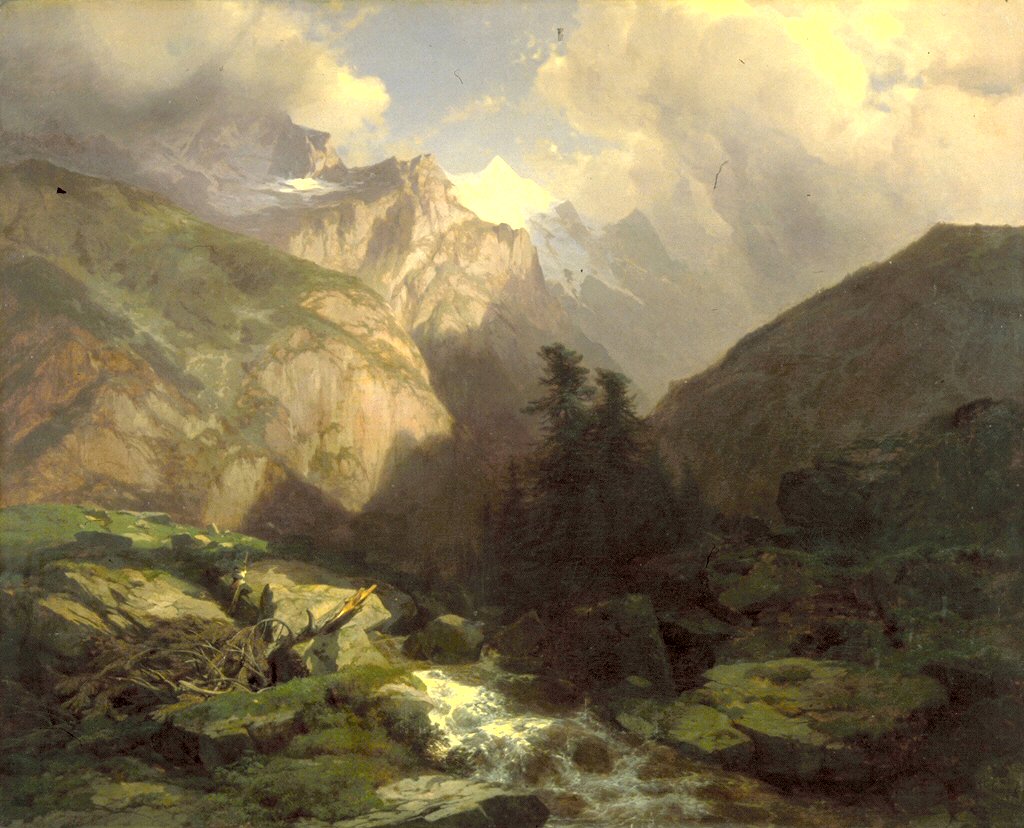
Alexandre Calame - The Jungfrau, Switzerland
{{PD-US}}
Alexandre Calame, Public domain, via Wikimedia Commons
2. Jungfrau and Lauterbrunnen Valley—The Valley of Waterfalls
{{PD-US}}
Alexandre Calame, Public domain, via Wikimedia Commons
Descending into Lauterbrunnen Valley feels like stepping into a living painting.
Vertical rock walls rise abruptly on both sides, streaked with waterfalls that spill freely from hanging cliffs.
Water tumbles in thin silver ribbons, catching sunlight as it falls into green meadows below, where wildflowers sway and wooden chalets rest quietly.
Above the valley, the Jungfrau massif towers with snowbound authority. Its peaks loom massive and serene, their glaciers glowing pale blue against the sky. The contrast is striking: gentle farmland below, raw alpine power above. Cowbells echo through the valley, their soft rhythm blending with the constant rush of falling water.
Mist drifts across the fields in early morning, blurring the edges of cliffs and waterfalls until the entire valley feels dreamlike. Trails wind through forests and past roaring cascades, leading deeper into a landscape where motion and stillness coexist. Lauterbrunnen does not overwhelm—it envelops, drawing visitors into its quiet, cascading beauty.

Aletsch Glacier and its snow-capped peaks
See page for author, Public domain, via Wikimedia Commons
3. Aletsch Glacier and Eggishorn—Rivers of Ice and Time
See page for author, Public domain, via Wikimedia Commons
The Aletsch Glacier unfolds like a frozen artery through the heart of the Alps, vast and ancient. From high viewpoints near Eggishorn, the glacier stretches endlessly, curving between mountain walls like a river paused mid-flow.
Its surface is textured with crevasses and ridges, shades of white, blue, and grey shifting with the light.
The silence here feels profound. Ice cracks softly in the distance, a reminder that this frozen mass is alive, moving slowly but relentlessly downhill. Surrounding peaks frame the glacier, their rocky faces dusted with snow, standing as witnesses to thousands of years of accumulation and erosion.
Looking down upon the Aletsch, scale becomes difficult to grasp. Trees shrink to dots, valleys widen, and human presence fades into insignificance. The glacier’s immense presence invites contemplation—of time measured not in days, but in centuries. This landscape does not rush; it endures.

Albert Zimmermann Peitlerkofel
Albert Zimmermann, Public domain, via Wikimedia Commons
4. The Dolomites—Sculpted Stone and Shifting Light
Albert Zimmermann, Public domain, via Wikimedia Commons
Unlike the smooth, ice-dominated Alps to the west, the Dolomites rise in jagged, dramatic forms that feel almost architectural.
Their pale limestone towers and serrated ridges thrust upward in sharp angles, catching light in ways that constantly reshape the scenery.
At sunrise and sunset, the mountains glow pink and orange, as if lit from within.
Wide alpine meadows spread beneath the peaks, dotted with wildflowers and grazing animals. Narrow paths lead hikers through rolling grasslands toward sheer cliff faces that rise abruptly, creating a powerful sense of contrast between softness and severity. The air feels lighter here, the sky broader, the stone sharper.
The iconic Tre Cime di Lavaredo stand like sentinels, three massive pillars guarding the horizon. Clouds drift past their summits, shadows slide across their faces, and the mountains seem to shift moods with every passing hour. The Dolomites are not merely seen—they are experienced through light, texture, and movement.

Signac montBlanc-nvg {{PD-US}}
Paul Signac, Public domain, via Wikimedia Commons
5. Mont Blanc and Mer de Glace—Majesty at the Roof of Europe
Paul Signac, Public domain, via Wikimedia Commons
Mont Blanc rises with undeniable authority, its snow-covered summit towering above surrounding ridges and valleys.
The mountain’s immense bulk dominates the horizon, its slopes etched with glaciers and icefields that cascade downward like frozen waves.
From afar, the peak glows pristine and untouchable; up close, it reveals complexity and raw power.
Below Mont Blanc lies the Mer de Glace, a vast glacier flowing through a steep valley like a frozen sea. Its surface ripples and fractures, darkened in places by debris carried from surrounding cliffs. Standing near its edge, cold air rises from the ice, sharp and invigorating, carrying the quiet sounds of cracking and shifting deep within.
Cable cars and mountain trains reveal sweeping views—endless ridges, plunging valleys, and layers of peaks fading into the distance. The landscape feels immense and humbling, a place where human ambition meets nature’s dominance. Mont Blanc does not simply stand above the Alps—it defines them.
Conclusion—The Alps as Living Landscapes
The Alps Mountains are not a single landscape but a collection of worlds shaped by ice, stone, water, and light. Each of these five regions reveals a different expression of alpine beauty: the iconic symmetry of the Matterhorn, the waterfall-laced serenity of Lauterbrunnen, the timeless scale of the Aletsch Glacier, the sculpted drama of the Dolomites, and the overwhelming grandeur of Mont Blanc.
Together, they tell a story of Earth’s creative power—landscapes in motion, carved over millennia, yet alive in every moment. To experience the Alps is not merely to observe mountains, but to stand within a living, breathing masterpiece of nature.


