 |
| Kota-Bundi Miniature painting Dildar Qureshi, CC BY-SA 4.0, via Wikimedia Commons |
Style and Symbolism in Indian Miniature Painting: A World Rendered in Color and Meaning
A jeweled court unfolds on a palm-sized surface. A Mughal emperor sits beneath a canopied pavilion, his face serene, his posture exact, his authority unquestioned.
Around him, attendants hover like carefully placed notes in a visual symphony, each gesture deliberate, each costume glowing with reds as deep as pomegranate seeds and blues reminiscent of crushed lapis lazuli.
This is the world of Indian Miniature Painting, where reality is not copied but reimagined, distilled into symbolism, rhythm, and narrative intensity.
Unlike Western realism, which sought to mirror the visible world with mathematical perspective and anatomical precision, Indian miniature painting pursued a different truth. Its artists were less concerned with optical accuracy and more invested in meaning, emotion, and power. The result was not illusion but revelation—a painted universe where every color, plant, and posture carried significance.
A Visual Language Beyond Realism
To step into an Indian miniature is to abandon the expectation of a single vanishing point. Palaces rise vertically instead of receding into space. Multiple moments in time coexist within one frame. A king may appear larger than his surroundings, not because of flawed proportion, but because hierarchy governs scale. Importance, not physics, shapes the composition.
Faces are often shown in profile, eyes elongated and almond-shaped, gazes fixed yet inward-looking. These stylized forms do not flatten emotion; they sharpen it. The tilt of a head, the curve of a wrist, or the slight bend of a knee becomes a coded gesture, instantly legible to a contemporary viewer steeped in courtly etiquette and literary tradition.
In this way, Indian miniature painting speaks a symbolic language—one that values clarity of narrative over illusion of depth, and spiritual resonance over surface realism.
 |
[1], Public domain, via Wikimedia Commons Painting: mahants Bhagwanji and Narainji |
The Power of Color and Gold
Color in Indian miniature painting is never passive. It pulses with intention. Rich reds announce royalty, passion, and divine energy. Ultramarine blues—once more precious than gold—cloak deities and emperors alike, suggesting cosmic authority and spiritual depth.
Emerald greens whisper of fertility, renewal, and paradise gardens. Gold leaf catches the light, transforming flat paper into a glowing surface that shimmers like a sacred offering.
These pigments were not chosen casually. They were ground from minerals, plants, and precious stones, binding the natural world directly into the artwork. Gold did not merely decorate; it sanctified. When brushed onto crowns, halos, or architectural details, it elevated the subject beyond the mortal realm, reinforcing imperial power and divine sanction.
The viewer does not merely see these colors—they feel them, as if the painting radiates warmth, devotion, and grandeur from within.
Nature Observed, Nature Idealized
While figures and architecture obey symbolic rules, flora and fauna often reveal astonishing observational accuracy. Lotus blossoms unfold petal by petal. Mango trees bend under the weight of ripening fruit. Birds perch with anatomical precision, their feathers delicately patterned, their beaks sharp and alert.
This botanical and zoological detail reflects more than decorative interest. It reveals a courtly culture deeply engaged with scientific curiosity and natural documentation. Mughal emperors, in particular, commissioned artists to record rare animals, foreign plants, and seasonal changes. The miniature thus became both artwork and archive—an illustrated encyclopedia of the known world.
Yet even nature is gently idealized. Gardens bloom eternally, untouched by decay. Animals coexist peacefully, arranged into visual harmony. The natural world becomes a reflection of imperial order—a microcosm of a perfectly governed realm.
Art as Manuscript, Memory, and Message
Indian miniature paintings were rarely standalone objects. They lived within imperial manuscripts, nestled between verses of poetry, chronicles of conquest, or sacred texts. Turning a page was an act of discovery: words dissolved into images, images into stories.
 |
| Krishna, the gopis and cows, Indra, and a royal couple English: thesandiegomuseumofartcollection, Public domain, via Wikimedia Commons |
These paintings were also political instruments. Presented as diplomatic gifts or displayed during court ceremonies, they reinforced lineage, legitimacy, and power.
A ruler shown hunting a lion was not merely engaged in sport—he was performing kingship, demonstrating courage, control, and divine favor.
Religious miniatures carried equal weight. Scenes from the Ramayana, Mahabharata, or Krishna’s playful exploits did more than illustrate scripture.
They invited devotion. They made the divine intimate. Gods laughed, danced, loved, and suffered—rendered small enough to hold, yet vast in emotional reach.
In these works, art, literature, and politics were inseparable threads woven into a single visual fabric.
Regional Styles, Shared Symbolism
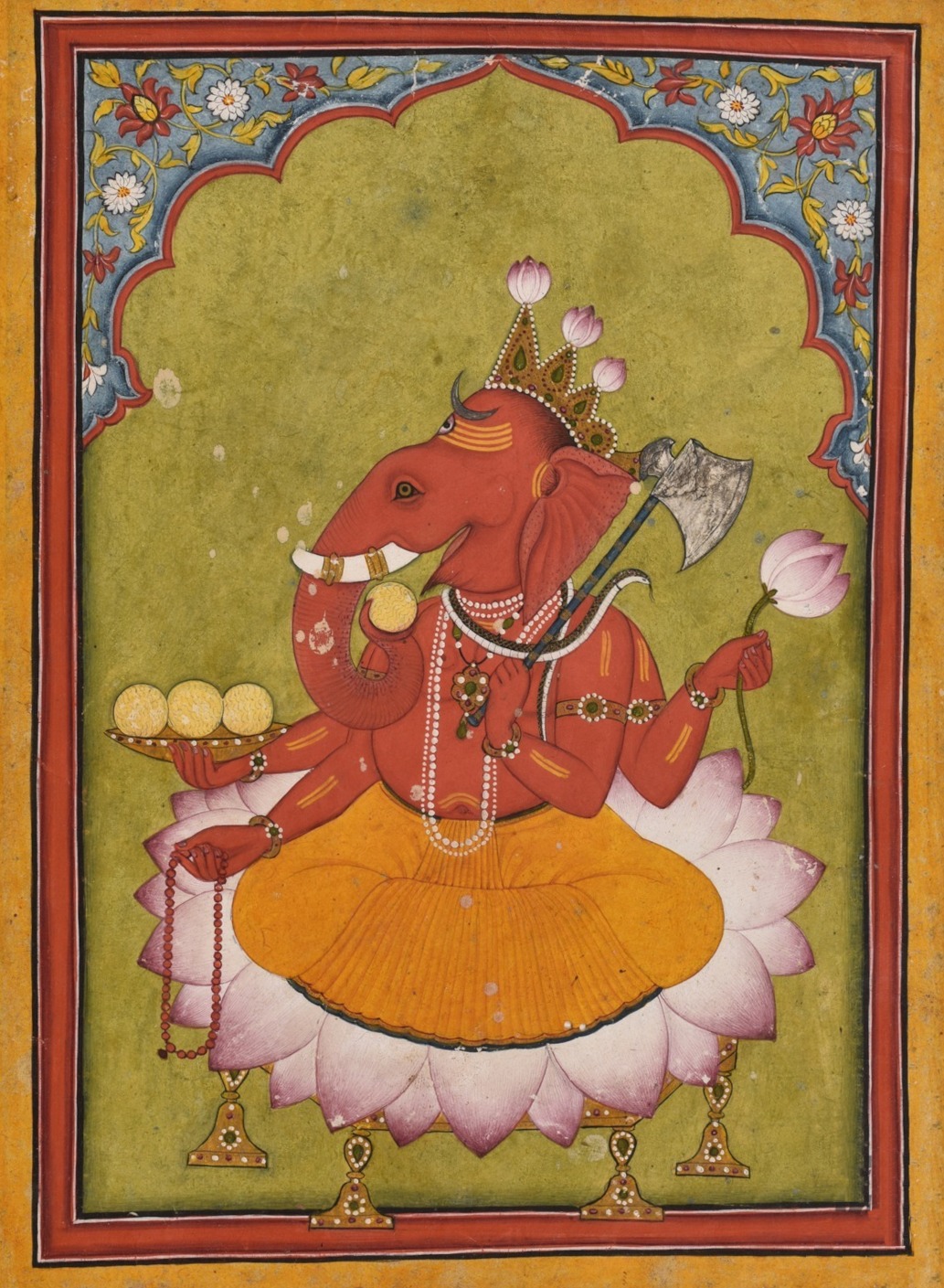 |
National Museum , Public domain, via Wikimedia Commons Lord Shree Ganesha. Basohli miniature, c. 1730. National Museum, New Delhi |
Across India, miniature painting flourished in distinct schools—Mughal, Rajput, Pahari, Deccani—each with its own palette, mood, and emphasis. Mughal miniatures favored realism infused with Persian elegance.
Rajput paintings burned with bold colors and heroic emotion. Pahari works softened into lyrical romance, misty hills, and poetic longing. Deccani miniatures glowed with jewel tones and dreamlike compositions.
Yet beneath these regional variations lay shared symbolic foundations: reverence for nature, hierarchical scale, narrative clarity, and emotional immediacy.
Whether depicting an emperor, a deity, or a lover waiting in the rain, Indian miniature painting consistently transformed lived experience into timeless visual poetry.
A World Where Meaning Reigns
To look closely at an Indian miniature is to realize how much is being said without words. A raised eyebrow suggests suspicion. A flowering tree signals monsoon and desire. A gold-bordered garment declares rank. Nothing is accidental. Everything participates in meaning.
These paintings do not ask the viewer to believe in illusion. They ask the viewer to enter a world shaped by values, stories, and symbols. In their small scale lies vast ambition—to preserve history, express devotion, and assert power, all within the delicate confines of paper and pigment.
Long after the courts have vanished and the empires faded, Indian miniature paintings continue to speak. They whisper of a time when art was not just seen, but read, felt, and remembered—a world where symbolism reigned supreme, and beauty carried authority in every carefully painted line.


![[1]](https://commons.wikimedia.org/wiki/File:Painting_of_the_mahants_Bhagwanji_and_Narainji_of_the_Pindori_Dham_complex_conjoined_together,_Basohli-style,_Pahari,_Punjab_Hills,_ca.1675%E2%80%931700_(colour).jpg)
.jpg)
